
Pitchforks
Democracy and the Mob

In countless stories the villagers gather at night. Someone has rung the bell. Torches are lit. Pitchforks come out of the barn. By morning the mob will be at the gates.
You know the scene: Frankenstein, Beauty and the Beast. The angry crowd storming the castle.
In those stories the monster is supposed to live inside the castle walls. But often it is the mob itself that becomes monstrous—the force that would suppress difference and punish change.
Lately I’ve been thinking about the pitchforks.
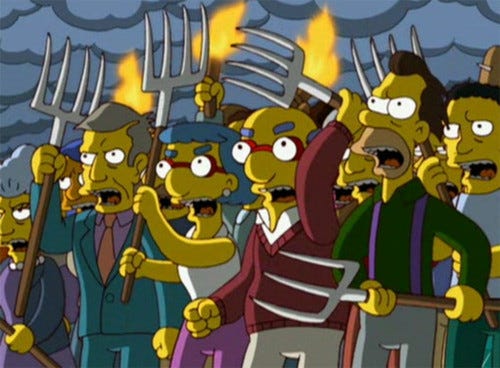
Mob Rule
Mobs needn’t target an individual. The real mob that comes most vividly to mind for me was the mob that stormed the Capitol building in 2020. Here the stated motivations of the participants seemed almost transparently superficial, comical even, the deeper motive seemed to be the thrill of collective transgression, the sudden intoxication of power among people who otherwise felt powerless.
Impotent may be the most important word of that last sentence. Martin Luther King Jr. said “a riot is the voice of the unheard.” These days I often find myself feeling angry and unheard. The Democratic leadership seems quite fond of reminding us how powerless we are in the face of fascism. I ask myself what is it that they are more afraid of: the fascists or the mob.
The term mob has telling origins. It comes from the Latin, mobile vulgus, meaning “the fickle crowd” or “the changeable masses.” The phrase came into common use in English in the late 17th century as a derogatory term used to decry the growing political influence of commoners. This tension between “the people” as the source of democratic legitimacy and “the mob” as a threat to order has existed for almost as long as modern democracies. In the French Revolution it was the mob, at least in part, that gave birth to modern democracy.
America’s founders were no strangers to this elite suspicion of the masses and they tried to engineer a republic that would rein in the impulses of a fickle and easily manipulated public. Hamilton warned us in his first Federalist paper of those who might ride the storm and direct the whirlwind. Today it feels as though we are all caught in the storm he warned about.
Perhaps the most frightening and consistent aspect of the mob is the way it allows individuals to evade the terror of moral choice by hiding inside “we.” This is perhaps the trick that Donald Trump does best. In his transgressive impulsive performance he gives his followers permission to be their worst selves, he promises them power and freedom, as long as they slavishly follow him. Fascism condenses the logic of the mob. It identifies the monster, directs the torches, and provides the absolution.
Fear of a Mob Planet
The mob is dangerous to democracy. But it is also dangerous to elites.
What has surprised me more over the past year has not been the depths of depravity of our leadership but rather the venality of elites who one assumed would resist. The more I have considered the issue, the more I suspect that what they fear is not the wrath of the state but the wrath of the people. They fear the public. They are more afraid of populism than of fascism. Populism threatens their position directly; fascism only threatens their sensibilities.
Perhaps they are right to be afraid. The Republican Party has undergone a populist (and I would argue ultimately fascist) transformation over the past decade under Trump. In doing so it has swept them into power, but it has also swept away the Republican elite of the 2000s and 2010s. Gone are not just the so-called centrists, but anyone willing to stand in opposition or rooted in principle. That is the danger of rule by the mob.
It is difficult to understand the recent rise of populism, nationalism, and even fascist politics without considering the role of social media. Social media has made outrage permanent, instantaneous, and personal. And the anonymity of the internet provides its own ready-made form of absolution. For many elites the threat of censure or cancellation feels more immediate than the slow erosion of democratic institutions.
What Is To Be Done?
What then should be done? Should we grab our pitchforks and march on the castle? I don’t think anyone serious is endorsing that. But it does seem that more acts of direct democracy and civil disobedience are called for.
The Democratic Party may be due for a populist transformation of its own. Short of that, those who would lead the opposition in this moment would do well not merely to mimic the language of populists (I’ve noticed more Democratic leaders swearing in their public statements) but to demonstrate courage through direct action.
Too often the tendency of Democratic leaders has been to fall back on institutional arguments about process and norms. To my ears, recent Democratic objections to the war in Iran sound less like opposition to a reckless war than irritation that they were not consulted. If Democrats hope to channel the immense anger welling among the public, they must at a minimum demonstrate conviction.
In the same speech in which MLK said that the riot is the voice of the unheard, he also defended his opposition to the war in Vietnam and spoke about the nature of leadership itself.
“Ultimately, a genuine leader is not a succor for consensus but a mold of consensus. And on some positions cowardice asks the question is it safe? Expediency asks the question is it politics? Vanity asks the question is it popular? The conscience asks the question is it right? And there comes a time when one must take a position that is neither safe nor politics nor popular but he must do it because conscience tells him it is right.” - Martin Luther King, 1968
MLK was not an elected representative but he was far from naïve about politics. More importantly, I think MLK understood that leadership is more important than politics. That one must lead first and the politics will follow. Is it too much to ask for leaders like this today?
In lieu of such leaders, perhaps it is incumbent on all of us to find ways for our voices to be heard. If we are to be a public and not a mob, we must begin with a sense of personal moral responsibility to one another.
I haven’t got a pitchfork. I left it behind in my move. A laptop and Substack will have to do for now.
We Still Have Music
Speaking of Pitchforks, here’s a playlist of mostly new music from albums I’ve been listening to a lot over the past year. It’s an eclectic mix, and probably not for everyone, but these are a few records that really stuck with me. Here are a few notes on some of them:
Sad and Beautiful World – Mavis Staples
She’s been around forever, but I really fell for Mavis after watching the documentary Mavis! about ten years ago. Since then she’s had a remarkable late-career revival, collaborating with artists I love like Jeff Tweedy, David Byrne, and most recently Kevin Morby. She even won a Grammy for her performance of Morby’s song “Beautiful Strangers” on her latest album. It’s hard not to root for both of them.
Euro-Country, CMAT
CMAT is a fearless Irish singer making bold, funny pop-country with a distinctly Irish swagger. She plays with country tropes—big feelings, bigger choruses—but with a wink. The whole album is full of romps.
Drive All Night, Thomas Dollbaum
Occasionally the algorithm spits up a pearl you never would have discovered otherwise. I don’t know anything about him and he doesn’t even have a Wikipedia page. Apparently he’s a poet from Tampa that lives in New Orleans. I like every song on this quiet little EP.
White Roses, My God, Alan Sparhawk
A veteran of the band Low, this is his first album since his Low co-creator Mimi Parker died in 2022, Alan Sparhawk has produced a very strange album. Drum machines and autotune replace Low’s slow-burn minimalism. The result is a series of warped little sound poems—half grief, half dance music. It shouldn’t work. Somehow it does.
Heavy Metal, Cameron Winter
If you follow indie music at all you’ve probably heard of Geese by now. Their sophomore album Getting Killed has rocketed them to fame, drawing praise from punk elders like Patti Smith and Nick Cave. Before that breakout, frontman Cameron Winter released a solo album that’s strange, enchanting, and often very funny. In this stripped-down setting you can really hear Winter’s beautiful, absurd songwriting. At times he sounds like a young Leonard Cohen who’s wandered off the rails.
Rosalia, Lux
This was probably my favorite album of 2025. Rosalía isn’t just fearless and original—she’s doing things no one else can do. The album somehow effortlessly blends orchestral music, opera, flamenco, reggaeton, and pop. If you haven’t seen her performance at the BRITs, watch it. It might be the best award-show performance I’ve ever seen.
Dance Called Memory, Nation of Language
I discovered them through a KEXP session on YouTube. They take the best elements of ’80s post-punk—driving basslines and bright synth lines—and turn them into powerful electronic ballads that feel like the best of New Order or Depeche Mode.