
The Darkest Timeline
Farce, Tragedy, and the Mutations of History

“Progress, far from consisting in change, depends on retentiveness. When change is absolute there remains no being to improve and no direction is set for possible improvement: and when experience is not retained, as among savages, infancy is perpetual. Those who cannot remember the past are condemned to repeat it.”
– George Santayana
"Hegel remarks somewhere that all great world-historic facts and personages appear, so to speak, twice. He forgot to add: the first time as tragedy, the second time as farce.” – Karl Marx
I’ve been rewatching the sitcom Community with my family recently. Created by Dan Harmon, it’s a brilliant, hillaious series that we all love. One episode, “Remedial Chaos Theory,” has become legendary: the characters roll a die to decide who has to pick up the pizza, and seven different timelines unfold. In the darkest timeline, the apartment catches fire, one character dies, another loses an arm, one turns to alcoholism, and another adds a blue streak to her hair. The mayhem spawned a now-famous meme: the darkest timeline.
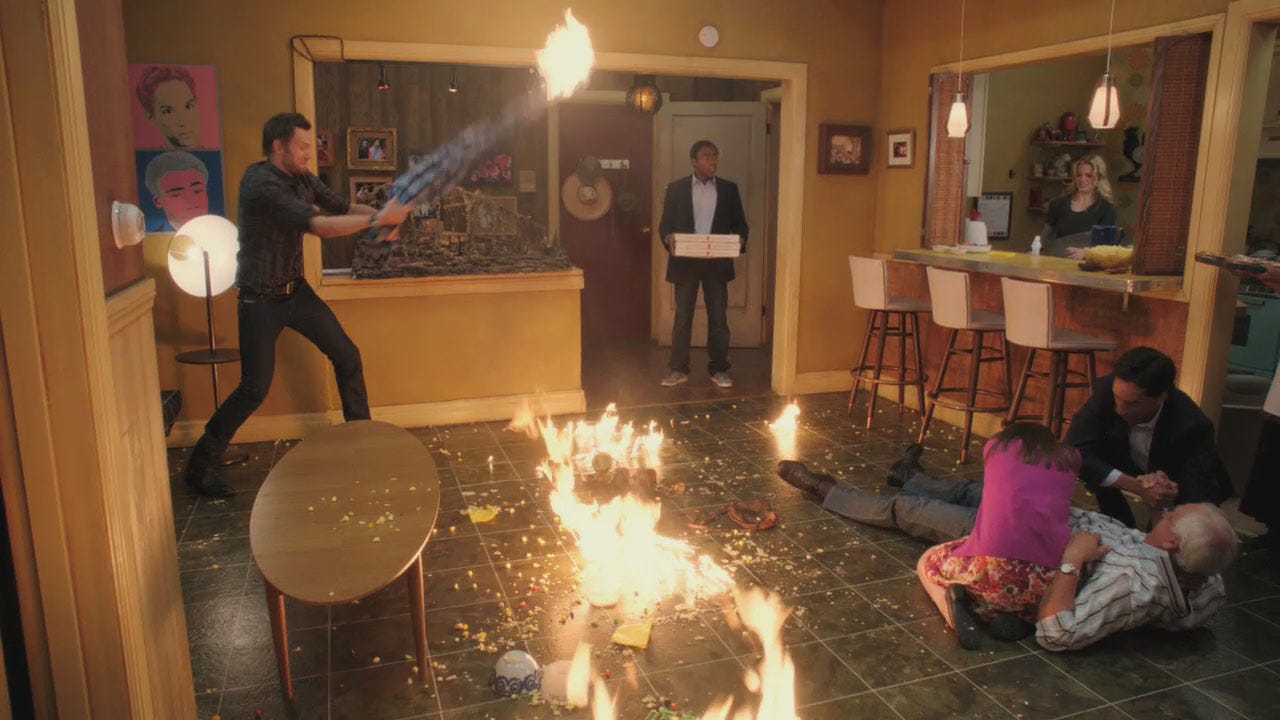
Lately, I find myself resonating with that meme more than I’d like.
If we had the benefit of foresight perhaps we could avoid the darkest timeline. Instead we are subject to the random roll of the dice. Or, we might choose not to roll the die of fate at all.
The Endless Cycle of Death and Rebirth to Which We are All Bound
The philosopher George Santayana once warned that without memory, we are condemned to a perpetual infancy, doomed to repeat the same mistakes. Freud had a similar insight when he noticed that many of his patients who had experience trauma seemed to recreate aspects of their trauma later in life. The psyche, he hypothesized, unconsciously seeks to replay the old pattern as if hoping for a different outcome.
The Buddhists have their own term for this: Samsara. When I was twenty and going through some things, I dropped out of college and moved to Burlington, Vermont, where I worked at a coffee shop called Samsara. The t-shirts we wore had the definition printed on the front, and it’s still imprinted in my mind: “Samsara: the endless cycle of death and rebirth to which we are all bound.”
Today it feels as though America has relapsed into its own cycle of unresolved trauma. Yet as both Buddhists and Santayana suggest, awareness offers a way out. True learning means remembering without becoming trapped by memory.
Civilization and its Discontents
My son has a prodigious memory. These days he applies it mostly to reciting facts about Taylor Swift, but he still astonishes me with his recall of historical detail. At museums, he explains the myths on a Grecian urn or the parable in a Renaissance painting—references I would have completely missed. Personally, I’m more at home in the modern and contemporary wings, admiring Picassos, Miros, Kahlos, and Rothkos.
Lately, though, I’ve been thinking more about myths and history and what they might tell us about the changes we are living through. I am perhaps at the age when men of a certain type turn to reading about the American Revolution, the Civil War, World War II, and Napoleon—but the truth is I have always been that age. Today my son’s recall and processing speed far outpace mine, but the apple doesn’t fall too far from the tree.
For Quartering Large Bodies of Armed Troops Among Us
Growing up in the Boston suburbs along the road to Lexington, the American Revolution was drilled into me early. We learned that Americans overthrew the yoke of a tyrannical king after he imposed taxes on imported goods and sent troops to occupy Boston. Among the greivances listed in the Declaration of Independence were:
Quartering large bodies of armed troops among us;
Cutting off our trade with all parts of the world;
Imposing Taxes on us without our Consent;
For depriving us of the benefits of Trial by Jury; and
Transporting us beyond Seas to be tried for pretended offences.
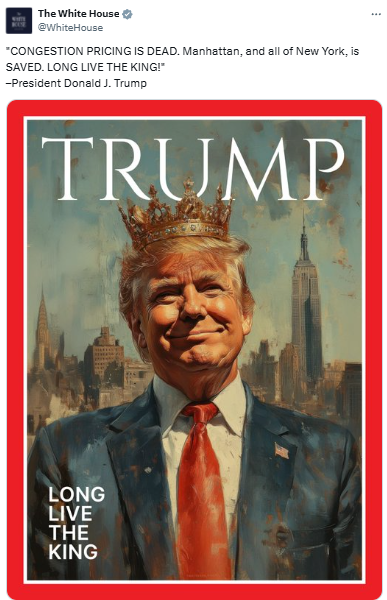
So it is surreal to watch, 350 years later, the imposition of arbitrary tariffs and the military occupation of major cities—this time by a leader who openly muses and memes about being a dictator or a king. This is precisely what George Washington feared. In his Farewell Address, he sketched the danger of the demagogue in words that read like prophecy today.
“When a man unprincipled in private life, desperate in his fortune, bold in his temper… despotic in his ordinary demeanor… when such a man is seen to mount the hobby-horse of popularity, to join in the cry of danger to liberty, to take every opportunity of embarrassing the General Government and bringing it under suspicion, to flatter and fall in with all the nonsense of the zealots of the day — it may justly be suspected that his object is to throw things into confusion that he may ride the storm and direct the whirlwind.”
Strange Mutations
It’s not surprising that the historical resonance of this moment seems lost on many. We are suffering from a kind of collective amnesia, as though the trauma of the pandemic left us unwilling to look back. To remember would be to acknowledge how fragile our daily lives really are.
As Santayana noted, progress requires memory. Our immune systems depend on it too. We enjoy freedom and survival today because of their miraculous ability to remember, learn, and adapt. B-cells and T-cells adjust to recognize and fight new pathogens, keeping us alive even as viruses mutate. Vaccines accelerate this process, helping our immune systems prepare a faster, sharper response.
Yet even immune systems can get stuck in samsara. The term Original Antigenic Sin describes how the body sometimes responds poorly to a new strain of a virus, relying on old models instead of adapting to new data.
A New Strain
Turning back to politics, America seems especially vulnerable to the new strain of fascism our leaders are offering. I’m struck by our institutions’ inability to recognize its virulence. They cling to an old model of politics — a world with shared facts, good-faith arguments, norms of civility, and respect for the rule of law. In that world, elections were contests of policy and persuasion, not existential battles over the survival of democracy itself. But our institutions keep behaving as if that world still exists, even as the stakes have fundamentally changed. It is their own version of Original Antigenic Sin.
Perhaps we are responding poorly because America has no close experience of fascism, or perhaps it is because this new strain of fascism comes cleverly disguised as a joke, a farce, a spectacle. To many in elite circles it seems too clownish, too self-parodying to pose a real danger — and so they fail to take it seriously. But that unseriousness is part of its power. It allows threats to be dismissed as comedy until it is too late. Some who voted for this regime even seem shocked when it does exactly what it promised to do.
This is kayfabe, borrowed from professional wrestling: the suspension of disbelief where everyone knows the show is fake, but agrees to treat it as real. Kayfabe works because it binds performer and audience in a shared illusion — not despite its artificiality, but because of it. The same collusion now defines our politics, creating a sense of belonging for those who feel “in on the joke,” even as the performance corrodes the line between spectacle and reality. The term itself comes from Pig Latin for fake — fitting for the farcical empire we find ourselves in today.
Farce and Fascism
Marx warned us about this dynamic. He observed that history repeats, first as tragedy and then as farce. By farce, he didn’t mean harmless comedy — he meant the kind of spectacle that blinds societies to real dangers until catastrophe follows. His example was Louis-Napoleon (Napoleon III), who came to power after the failed French Revolution of 1848 promising order, religion, family, and property. Mocked by elites as ridiculous, he was nevertheless elected by an overwhelming majority of peasants who saw in him a chance to restore the national glory of his uncle. Once in power, he declared himself emperor, imprisoned his rivals, and ruled for two decades — until his reign ended in humiliation at the hands of the Germans at the Battle of Sedan. The French empire collapsed.
What begins as farce ends in tragedy.
Historian Eric Hobsbawm described Napoleon III as “the first modern dictator,” a man who ruled “not through brilliance but through myth.” I can’t help but hear an echo today.
History doesn’t simply repeat; it mutates. Like a virus, it returns in altered form. If we cling to old models, we miss its danger.