
Tomorrow Land

Auckland is eighteen hours ahead of the U.S., which means our Monday mornings are still Sunday afternoons back in Boston. It’s a rainy Monday here, the weekend still unfolding back home. I did the Sunday crossword before falling asleep. As an inveterate New York Times crossword user, it still feels like a small indulgence to get it early.
Sarah is off early to beat the traffic, and the older two have a bus to catch for school. It’s just me and Frida—and Frida is sleeping in, enjoying the last few days of what must be the strangest summer vacation of her eleven years. Soon it will just be me, left to make of this world what I may—Robinson Crusoe, minus the carpentry skills.
Life’s a Beach
The rain comes after nearly a week of immaculate weather. Each day felt like a perfect May day back home: partly cloudy, bright blue skies, highs in the mid-seventies. I tried to take advantage of it.
On Friday, Frida and I took the bus to the nearby city beach, Mission Bay, where a narrow strip of sand faces north toward the green harbor islands of Rangitoto and Motutapu. The beach is bordered by a park and a small but busy strip of sidewalk cafés and ice-cream parlors. Donning my swim trunks—togs, in New Zealand parlance—I waded into the water with Frida, and after some hesitation we finally submerged ourselves in the cool Pacific.
On Saturday, with the whole family home, we ventured a little farther to Eastern Beach, about a twenty-minute drive from our house. We arrived at low tide and wandered out nearly three hundred meters, water up to our ankles, weaving among plovers, gulls, and clam beds in the warm shallows.
By Sunday, unwilling to waste another perfect day, we headed south to the Hunua Range, about twenty-five miles from the city. Gradually the subdivisions and box stores of South Auckland gave way to hills and gullies and green pastures dotted with grazing sheep and cattle. There we found an eighty-meter-high waterfall plunging into a placid pool, where we picnicked alongside a family of ducks. My more ambitious plans to hike deeper into the range were cut short by a trail closed due to “slips” (landslides, in American English), and by family members who do not share my enthusiasm for prolonged ascents into nature.
Peregrinations
With many of the logistics of the transition now behind us, I’ve had time to explore Auckland and its surroundings—although, without a vehicle, I’m confined to foot and transit for the moment. Near my house is a small wetland reserve that makes for a good walking loop. Aucklanders love to walk their dogs off leash and seem perfectly content to let them splash through puddles and ponds. I enjoy watching the birds: swallows, ducks, black swans, mynas, pūkeko (a goofy-looking swamp hen), and the occasional parrot all make appearances.
Walking, however, is not without its discomforts. First there is always a chance of rain. Then there are the hills, which I’ve mentioned before—steep, long, and seemingly unavoidable. Main roads tend to run along ridgelines, while cross streets are few and far between. Instead, large lots have been subdivided into smaller parcels connected by long, shared driveways that wind down into the gullies, effectively forming cul-de-sacs. The varied houses climbing these green hillsides create a beautiful landscape, drawing the eye upward and outward and making the most of the terrain—even if the street network they sit within is poorly connected. It is a reminder of how topography, more than policy or planning, shapes a city. Still, Auckland’s transport system would benefit from more walking and cycling links that cross the gullies between ridges. Good alleyways make good cities.
More disconcerting is the scarcity of crosswalks. Auckland Transport appears to have invested heavily in speed bumps and other traffic-calming measures, but has been far more sparing with pedestrian crossings. Having grown accustomed to Massachusetts’ yield-to-pedestrians laws, I find it unsettling to negotiate each crossing from a position of disadvantage. Walking often feels like asking permission. Pedestrians are effectively second-class users of the system, marginalized to the sidewalks. Auckland would benefit from clearer pedestrian-priority laws and a more liberal use of paint—zebra-striped crossings at intersections and mid-block crossings to break up long stretches with nowhere safe to cross.
More troubling still are partially signalized intersections with slip lanes, where vehicles are permitted to turn at speed just as pedestrians begin to cross. There are “give way” signs at these locations, but they are frequently ignored. After encountering several such intersections on the route to my eleven-year-old’s school, I quickly decided it would be unsafe for her to walk there on her own. While left turns on red are illegal in New Zealand, slip lanes and wide turning radii remain common. Neckdowns should be a standard treatment at intersections like these, not an exception.
Safety is a prerequisite for freedom. Unsafe transportation environments don’t just put people at risk; they constrain them. And it is always the most vulnerable who feel those constraints first. To my mind, transportation planners and policymakers should begin with children and work outward from there. Before anything else, transportation systems should be safe, accessible, and affordable for everyone. Safer routes to school are a good place to start.
Ridges and Gullies
Still, even as I continue to find much to enjoy and explore in Auckland, some critiques are beginning to form as my impressions mature. There is a temptation, once one has made a big decision, to search for evidence that it was the right one—and to dismiss whatever complicates that story. Throughout this transition—this conscious decoupling, if you will—I have found myself thrown between hope and doubt, optimism and pessimism, joy and regret. It is no wonder Kierkegaard described freedom as a kind of vertigo, or that Nietzsche imagined his prophet Zarathustra as a tightrope walker. One moment the sun is shining on a gorgeous beach and everyone is smiling; the next, one’s daughter is sick with anxiety about starting school, and the thought arrives unbidden: What have I done?
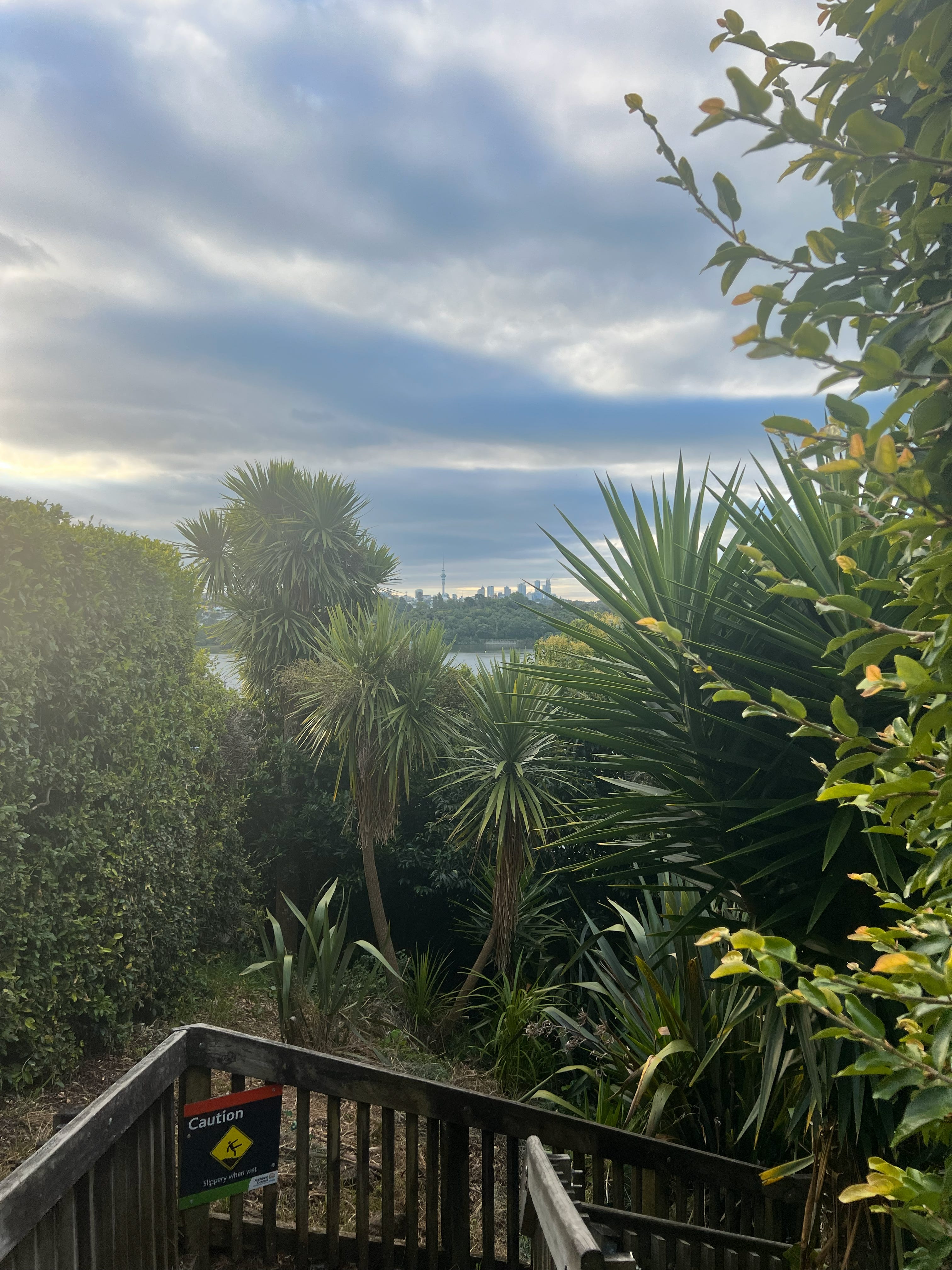
On a walk the other evening, I came across a rare pedestrian lane cutting between two ridges. The unmarked path slipped between houses and gave way to a steep descent, until the homes fell away and a small stream emerged below. Lilies and giant ferns crowded the shadowed bank, and hidden frogs croaked a melancholy song. I paused for a moment on the narrow footbridge, then climbed again into the suburban evening.
I should take more pictures

Wow! So glad you are enjoying this new season!