
Waitangi Day

Waitangi Day
It’s Waitangi Day in New Zealand, so my kids have the day off school. Frida is running a fever, which means I’m home doing laundry while Sarah heads to a festival with the older two.
Waitangi Day commemorates the signing in 1840 of the Treaty of Waitangi, the foundational agreement between Māori rangatira (chiefs) and representatives of the British Crown. The meaning of the Treaty has been contested ever since. British officials understood it as transferring sovereignty over New Zealand to the Crown; most Māori signatories, by contrast, understood it as establishing a framework in which the British would govern their own settlers, while Māori retained authority over their lands, resources, and communities.
To mark the signing of the Treaty, citizens and political leaders gather each year at Waitangi in the far north for a week-long series of events. There are celebrations of Māori culture, formal ceremonies, speeches, and protests. Politicians arrive fully expecting to be heckled, challenged, and confronted. It is an unusual national holiday—marked as much by tension as by celebration—reflecting the unresolved legacy of colonialism, migration, and an agreement whose meaning is still being argued over nearly two centuries later.
Today in New Zealand, Māori people make up roughly 20 percent of the population, with higher concentrations in the rural areas of the North Island. Before coming here, my knowledge of Māori culture was limited to the haka performed before international rugby matches and the striking facial tattoos.
Māori arrived in these islands centuries before European settlers, and despite colonization their presence endures as a constitutive element of New Zealand’s identity. That distinction becomes clear in everyday life through the widespread use of Māori language and the frequent invocation of Māori values in professional and institutional settings. As I began networking with New Zealanders and scanning job listings, this stood out immediately.
To my North American eyes, it initially felt odd. At worst, it read as cultural appropriation; at best, a form of virtue signaling. Why was a job listing at Auckland Airport quoting Māori proverbs? Why were European New Zealanders signing off their emails with ngā mihi nui? And—most awkwardly—was I expected to respond in kind?
Living here now, I’m beginning to understand the how and why behind New Zealanders’ use of Māori language. New Zealand is not a bilingual country—at least not in the way I’ve experienced bilingualism elsewhere. I’ve lived in Québec and in Paraguay, two places where language politics are embedded in everyday life.
In Québec, language is overtly political: French is asserted as a marker of regional and cultural identity in the face of a dominant anglophone majority. In Paraguay, Spanish functions as the lingua franca of government, education, and elite life, while Guaraní is spoken at home by nearly everyone. Bilingualism there is lived, informal, and socially pervasive.
New Zealand is different. Few non-Māori are fluent in Māori, and English remains the default language of public communication. And yet Māori language is firmly established in official and formal settings—in government, education, public ceremonies, and professional life. Its presence reflects not widespread fluency, but a deliberate civic and historical orientation.
In the United States, gestures of recognition often stop at symbolism, while living Native peoples and cultures are too easily confined to the past. Over the past decade, land acknowledgment statements have become common in progressive circles as a way to signal respect and reconciliation with the original inhabitants of the lands we colonized. Without a substantive foundation in legal rights or institutional power-sharing—such as those recognized by the Treaty of Waitangi—these statements often feel thin. To many, myself included, they risk becoming a form of ritualized virtue signaling: a moral performance enacted largely for a white audience, a kind of symbolic penance, disconnected from any durable redistribution of authority or responsibility.
Living here, I’m beginning to appreciate the use of Māori language and symbolism in New Zealand, even as significant socio-economic gaps between Māori and European settlers persist and much work remains to be done to achieve—borrowing an American phrase—a more perfect union.
I’m coming to see the use of Māori words and values, the performance of the haka, and the honoring of Māori traditions as an invitation to something deeper. Taken together, they suggest an openness—to relationship, to history, and to the idea that this society rests on more than a single cultural foundation.
Accepting that raises a simple question: what are we trying to build? In a shared political community, we still have to learn how to live together.
In the near future, fluent bilingualism is probably not realistic, nor does full integration in the American melting-pot sense seem desirable. Instead, New Zealand appears to be groping toward a model that treats cultural difference as enduring and valuable. The goal, perhaps, is a shared community that can create something new without forgetting the meaning and obligations created by the past.
This vision feels all the more important now that New Zealand’s population extends well beyond descendants of British settlers and Māori alone. In Auckland, the Asian diaspora now accounts for more than 30 percent of the population, outnumbering Māori by nearly three to one. Meanwhile, an ongoing affordability crisis is pushing tens of thousands of native-born Kiwis across the Tasman Sea to Australia in search of better prospects.
Global migration patterns create strange vignettes: in Takanini, where my wife teaches, teachers from Canada, the UK, and Korea are teaching Māori words and concepts to a school population that is mostly Indian.
For some, this is too much. They would like to sort it out, impose order, and put everyone back in their proper place—usually with their own kind, whoever that may be, on top. I think it’s far too late for that. We live in a mixed-up world, and I happen to like it that way.
There is a way in which, when asserting our diverse identities, we cling too tightly to categories that do our complex, mixed-up selves no justice. In the United States, I’ve never known which box to check when asked to describe my own children’s ethnicity. Are they Hispanic? They’re a quarter Mexican, but just as Italian as they are Mexican.
In New Zealand, where there are relatively few Latin American immigrants, I scrolled through a long list—Māori, Tongan, Indian, New Zealand European—without finding anything that quite fit. “New Zealand European,” perhaps, but they aren’t really New Zealanders yet, nor Europeans anymore. Eventually, I gave up and typed in “American.” It seemed as good an answer as any.
Postscript
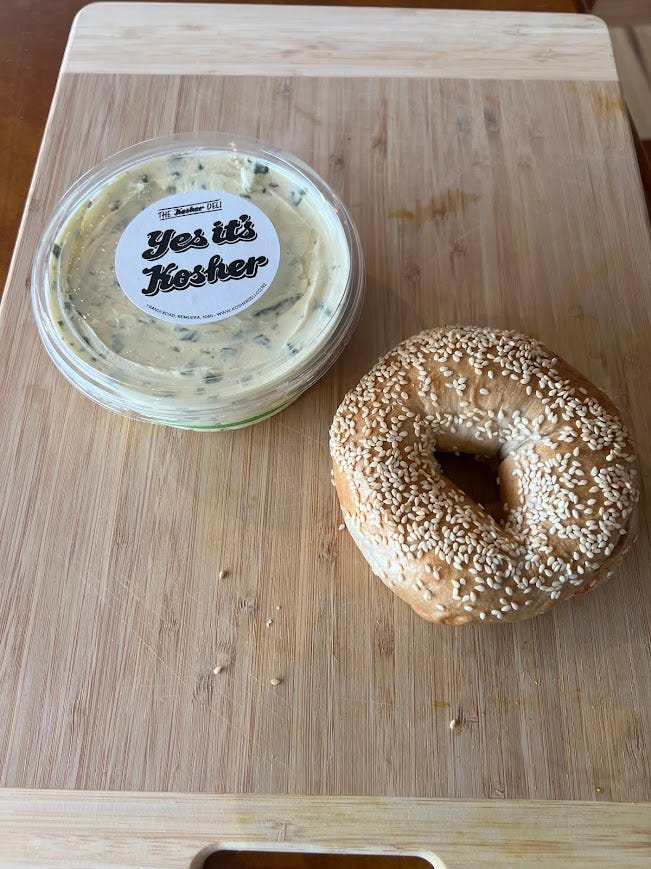
On my way home from Frida’s school yesterday, I stumbled across a kosher deli. There are no more than ten thousand Jews in New Zealand, but somehow I had found them. I went inside and asked if they had any bagels. Sesame bagels—still hot.
I bought a package of four, which the man handed to me in a paper bag. Seeing my excitement, he smiled and asked my name, and I told him. On the walk home, I held the bagels close to my chest. I ate one warm and untoasted with a smear of scallion cream cheese, the way God intended. They were so good I almost cried.
Hi Aaron - I am so enjoying your articles and am in awe of you and your family’s gumption in moving to NZ. (We are visiting Savannah this week … words like gumption and y’all are creeping back into my vocabulary after being away from the south for many years). I look forward to reading more of your SubStack … best of luck to y’all in your adopted corner of the world! :)
You found your NZ madeleine moment 👍