
Welcome to Aotearoa

Arrival
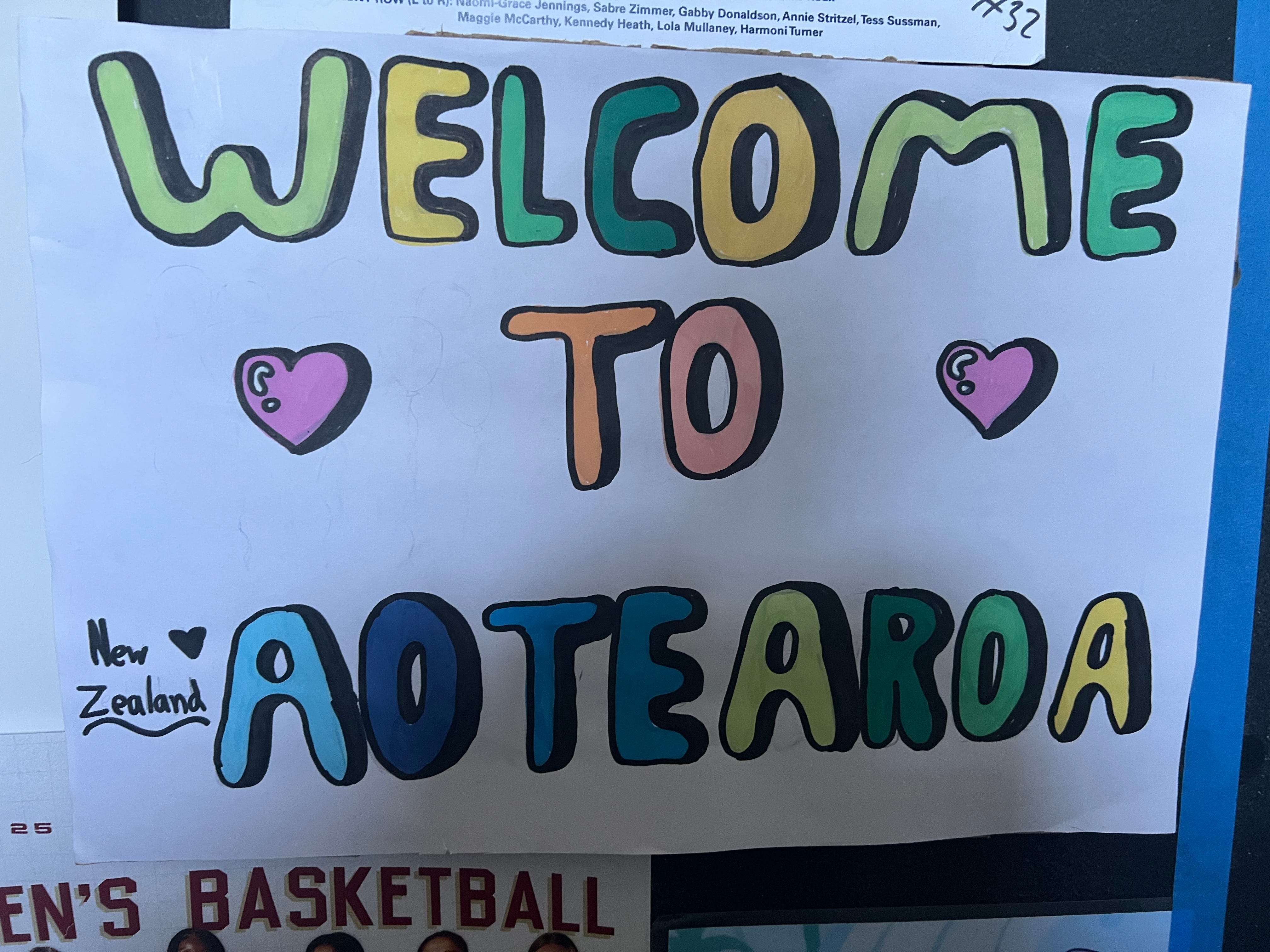
Ten days ago we landed at Auckland Airport after nearly thirty hours of travel. Just past customs, we were greeted by a smiling Kiwi family holding a hand-drawn Welcome to Aotearoa sign and offering us two flat whites. Exhausted from the flight, I was not emotionally prepared for either the kindness or the quality of the coffee. They loaded us and our unreasonable amount of luggage into their van and drove us to our new home in Remuera, a hilly bedroom suburb I had previously encountered only as a pin on Google Maps and a handful of unnarrated dashcam YouTube videos—which, in retrospect, was not much to go on.
The last ten days have been a blur of errands and small discoveries. If I had any lingering fantasy about giving away all our possessions and starting a minimalist new life, it evaporated quickly. While the vast majority of our belongings sits in a warehouse in Hopkinton, Massachusetts, waiting for a container ship and a six-week sea voyage, we’ve been renting furniture, stocking a kitchen from scratch, buying a car, and replacing the appliances and furniture that won’t be making the trip to the Southern Hemisphere. The result is that my kitchen is currently full of cardboard boxes from the newly opened IKEA New Zealand.
Biggest Surprises
One of my biggest surprises so far is that there is a 24-hour K-Mart about fifteen minutes from my house. It’s strange to encounter a seemingly defunct American brand living its best life abroad. If K-Mart can do it, perhaps I can too.
We are very new here and still learning, so the following impressions should be taken with a very large grain of salt.
New Zealand is a land of giants. My wife and I, who have never thought of ourselves as small, are suddenly unremarkable in stature. Men and women—European, Māori, Pacifica—are solid, tall, broad-shouldered. It is immediately clear why this country is a rugby superpower.
Auckland is far hillier than it appeared on my computer screen. The city sits on a series of extinct volcanic cones that rise abruptly out of the urban fabric—green, steep, and impossible to ignore. Beyond them, the land undulates in ridges and valleys that make walking feel more athletic than anticipated. What makes for a five-minute drive is often a forty-five-minute walk.
Transportation-wise, Auckland is sprawling and car-oriented, with congestion that feels familiar to anyone from Boston. It took me almost a full week to work up the nerve to drive on the left. My wife, being braver and more decisive, has done most of the driving. Locals complain constantly about the transit system, but there is a bus near my house with ten-minute headways that can get me downtown in under forty-five minutes, so I can’t complain too much.
The cost of living is high. Groceries are expensive. Fuel is expensive. Housing is very expensive. I’m trying to stop converting prices into U.S. dollars in my head—after all, I hope to be earning New Zealand dollars soon. Despite the costs, Kiwis seem well adapted to this reality: thrift shops abound, and Trade Me—the local eBay equivalent—is a minor institution. Resourcefulness appears to be a quiet national skill.
The weather has been mild, breezy, and deeply unreliable. Our first week included the tail end of a tropical storm that flooded parts of the north and dumped a month’s worth of rain in two days. Since then, we’ve had days that cycle through cloud, sun, rain, wind, and back again, often punctuated by a rainbow. No one here seems to trust the forecast. People walk around in shorts and T-shirts carrying umbrellas, just in case.
Finally, there is the reserved friendliness and unreserved hospitality of those we’ve been able to connect with. This past Saturday we were taken on a tour of the Piha area by an American expat who has lived in Auckland for twenty years. We squeezed into his SUV along with his rescue dog and drove west over a small mountain range to a dramatic stretch of black-sand coastline. A prodigious talker, he generously supplied us with local history and Māori vocabulary as we went. We hiked to a waterfall, where my youngest, Frida, dunked herself into the frigid freshwater, and then arrived at the beach just in time for a sudden gale of wind and rain that sent us running for cover beyond the dunes. We finished the day with meat pies and a damp drive home.
It felt like a proper introduction.
Giant Leaps and Small Steps
All in all, it’s been about as good a start as we could reasonably have hoped for when we began planning this journey many months ago. There are still some large pieces not yet in place. I’m still looking for work, and our kids start school later this week, which makes me a little anxious on their behalf. All that said, the giant leap has been taken. Many small steps remain.
I’ve been thinking lately about a slim, unassuming book I read in graduate school, Development Projects Observed, in which Albert O. Hirschman describes the Principle of the Hiding Hand: the idea that people often take on ambitious projects because they underestimate the challenges—and that this miscalculation can sometimes work in our favor. That has certainly been true of this move. It wasn’t the arrival that proved most challenging, but the moving itself—the logistics, the uncertainty, the unexpected costs without a clear payoff. And yet we pushed through it and made it here relatively unscathed, perhaps even stronger for it. What mattered most wasn’t the quality of our planning, but the shared commitment my wife and I bring to this—our values, our willingness to compromise, and our ability to adapt when things didn’t go as expected.
Now we are here, and the intangibles—the cherished realm of theory—are finally tangible. It’s not paradise. There are still open questions, trade-offs, costs, and uncertainties ahead. But the sun is shining, the coffee is good, and we have each other.
What more can one ask for?
Epilogue: Thinking of Home
I woke on Sunday to the terrible news of Alex Pretti’s killing—an ICU nurse, a federal employee, a peaceful observer, a good Samaritan, murdered for the crime of loving his neighbor.
It was our saddest day since arriving in New Zealand. Months ago, when we first began planning this move, these were precisely the fears that weighed on us: the normalization of state violence, the erosion of civil liberties, the harassment and detention of people on little or no basis, protestors shot in the street, imperial ambitions abroad. A month ago—even a week ago—many might have dismissed these fears as exaggerated. After Pretti’s killing, that dismissal became far harder to sustain.
On Monday morning, I watched the Patriots defeat the Denver Broncos in the snow. One never feels more American than when one is abroad.
By Tuesday, the tide seemed to be turning. Border Patrol was leaving Minnesota. The people of the Twin Cities could claim a measure of victory. But at what cost? Values are a curious thing. Most days they exist as mere words—abstract, weightless—until the moment comes when someone is willing to die for them. Values always come at a cost. But there is also a reward: they remind us of who we are, and, perhaps more importantly, what we are for each other.
Bonus Content
Whether I’m feeling mad or happy or sad or like having a dance party I like to listen to Bob Marley. So here’s 13 of my favorite Marley songs to play loudly in your kitchen or car or wherever you are.